Last Updated on 22 seconds ago by ackleyadam
Key Takeaways
- Sandling Industrial Services offers a skid-mounted automatic backwashing sand filter rental for industrial water and wastewater applications.
- The published rental unit is intended for suspended-solids filtration in the approximate 15 to 20 micron range.
- Published specifications list a four-tank pod configuration, a 504 to 756 GPM design flow range, 80 PSI maximum operating pressure, and an approximate operating weight of 18,000 pounds with media.
- Successful deployment depends on an application review that addresses flow, water quality, pressure, backwash handling, site access, utilities, and timing.
- Rental filtration can be useful during maintenance, construction, emergency response, process changes, and short-term capacity needs.
What Should an Industrial Facility Do When Suspended Solids Disrupt Water Treatment?
When suspended solids begin to interfere with process water quality, wastewater treatment, discharge management, or downstream equipment protection, a temporary filtration system can provide a practical bridge. Meanwhile, the permanent process can be repaired, expanded, or evaluated.
An industrial skid-mounted sand filter rental can help a facility add filtration capacity without immediately committing to a permanent equipment purchase. Sandling Industrial Services provides rental, repair, maintenance, and water-treatment support for industrial and municipal customers.
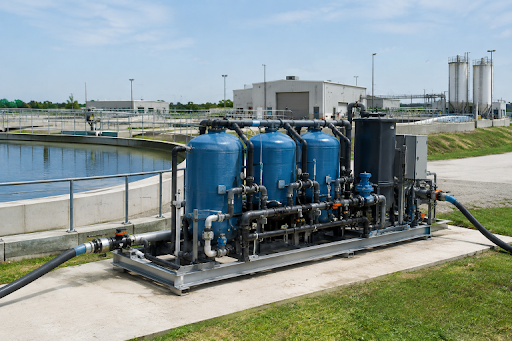
Its skid-mounted sand filter rental is a high-rate, automatic backwashing sand media system for the general filtration of organic and inorganic suspended solids. The right application still depends on site-specific conditions, including influent quality, hydraulic loading, available pressure, and the facility’s ability to manage backwash water.
Why Consider Sandling Industrial Services for Temporary Filtration?
A rental system can be especially valuable when the need is urgent but temporary. Planned maintenance, construction tie-ins, equipment failures, seasonal loading changes, and commissioning work can all create a short-term gap in solids-control capacity.
Rather than relying on a one-size-fits-all approach, the equipment and site conditions should be reviewed before a rental is approved. Sandling Industrial Services presents itself as a nationwide provider of rental filtration and mechanical dewatering equipment.
Its broader service capabilities may also be helpful when filtration is only one part of the project, and the site needs support for sludge handling, repair work, maintenance, or related temporary equipment. Backwash planning deserves the same attention as filter sizing.
In granular-media filtration, collected solids raise resistance through the media bed over time, and the filter must be cleaned to restore operating performance. The basic backwashing process reverses the flow through the filter media, loosening accumulated material so it can be removed with the waste stream.
How Does the Sand Filter Rental Work?
- Water enters the filter vessels and moves through the sand media.
- The media captures suspended solids while filtered water passes through the underdrain and leaves the system.
- As solids accumulate, the pressure differential across the media bed increases.
- At an approximate 10 PSI pressure drop, the automatic controls initiate a backwash cycle.
- The valve arrangement reverses flow through the vessel being cleaned.
- Clean water from the operating vessels lifts and expands the media bed, carrying captured solids away in the backwash stream.
Backwashing is a core operating function, not an optional add-on. Its purpose is to restore media permeability and remove the solids that have collected during filtration. Facilities should plan for the volume, rate, destination, and treatment requirements of the backwash stream before equipment arrives on site.
Published Rental Unit Specifications
Sandling Industrial Services publishes the following information for its Yardney Model IL5424-4AS3 rental system. These details should be confirmed directly with the company during the application review, since actual project requirements and equipment availability can vary.
- Filter type: Skid-mounted, high-rate automatic backwashing sand media filter.
- Configuration: Four-tank pod system.
- Design flow range: 504 to 756 gallons per minute.
- Backwash rate: 15 gallons per minute per square foot, with approximately 190 GPM listed for the system.
- Maximum operating pressure: 80 PSI.
- Suggested minimum operating pressure: 30 PSI.
- Power options: 120-volt controller, 24-volt AC solenoids, or remote battery operation with solar-cell recharge.
- Approximate operating weight: 18,000 pounds with media.
- Air requirement: At least 2 CFM at 70 PSIG where required.
Where Can Temporary Sand Filtration Help?
Maintenance and Equipment Outages
A rental filter may help sustain treatment capacity while a permanent filter, clarifier, pump system, or related process equipment is taken offline for maintenance or repair. It can also provide a contingency option when a sudden failure creates an immediate suspended-solids concern.
Construction, Startup, and Temporary Capacity
Contractors and facility teams may need temporary filtration during bypass work, plant upgrades, commissioning, startup, or phased construction. A rental arrangement can also help when flow increases for a defined period, but long-term demand does not yet justify a permanent capital project.
Variable Water Conditions
Sand media filtration performance depends on influent solids concentration, particle characteristics, water chemistry, flow, media condition, and operating procedures. For that reason, a system that performs well at one facility may require different operating controls, pretreatment, or backwash handling at another.
How to Prepare a Useful Rental Request?
- Define the objective: Explain whether the project involves suspended-solids removal, discharge control, process protection, reuse preparation, or temporary treatment capacity.
- Provide flow information: Include average, minimum, peak, and projected flow rates.
- Describe the water: Share available turbidity, total suspended solids, particle-size information, temperature, pH, oil and grease data, and known chemical constituents.
- Review hydraulics: Confirm inlet pressure, required outlet pressure, pump capacity, hose routing, and piping limitations.
- Plan backwash handling: Identify where backwash water will be collected, discharged, treated, stored, tested, or reused.
- Confirm site logistics: Review road access, equipment placement, ground support, lifting needs, utility access, security, and operator access.
- Set the schedule: Provide delivery timing, expected rental duration, commissioning requirements, and demobilization expectations.
What Should Be Confirmed Before Approval?
- Does the expected flow fit the published 504 to 756 GPM design range?
- Can the site provide the suggested minimum operating pressure of 30 PSI without exceeding the 80 PSI maximum operating pressure?
- Can the site safely receive and support equipment weighing approximately 18,000 pounds with media?
- Are the required electrical controls and, where needed, compressed-air supply available?
- Can the facility manage approximately 190 GPM of backwash flow?
- Has the backwash stream been reviewed for discharge, storage, treatment, reuse, and applicable permit requirements?
- Has Sandling Industrial Services reviewed the water, logistics, and project schedule before finalizing the rental?
Rental Versus Permanent Equipment
A rental is not automatically the better choice. Permanent equipment is often appropriate when a facility has stable, long-term treatment demand and a confirmed lifecycle plan. Rental equipment may be a stronger fit when speed, flexibility, limited capital exposure, temporary capacity, or a short project duration is the primary concern.
For facilities facing a suspended-solids challenge, Sandling Industrial Services offers a practical starting point for evaluating temporary filtration. A complete application review can help determine whether the published sand filter rental configuration, site utilities, backwash plan, and operating conditions align with the project’s actual needs.
Conclusion
Temporary sand filtration can help industrial facilities manage suspended solids during maintenance, construction, equipment outages, or short-term increases in treatment demand. Sandling Industrial Services offers a skid-mounted automatic backwashing sand filter rental with published specifications that may suit certain high-flow applications.
However, successful use depends on more than matching the required flow rate to the equipment. Facilities should review influent water quality, operating pressure, backwash handling, site access, utilities, and project timing before arranging a rental.
Comparing these requirements with the system’s capabilities can help determine whether temporary filtration is appropriate for the application or whether another treatment approach or a permanent solution should be considered.